
Loss After Survival
“Survival can carry grief,” a lesson I learnt about trauma and loss. Read the Grief Story, 'When Grief Has No Name,' by Catherine Hannah about PTSD and grief after a road traffic accident.

Welcome to the Grief Stories community! I hope you find this to be a welcoming place where you’ll be able to share experiences, get things off your chest, support one another, ask questions, and chat to people who truly ‘get it’. I invite you to read and share stories of hope and healing; giving a voice to loss and grief. This is a safe place helping us to feel less alone on our journey and providing comfort in hard times.
Sometimes loss doesn’t end when we survive something - it begins there in ways we don’t immediately recognise.
When life continues, when no funeral is held, and when others move on believing “no one died,” it can become difficult to name what we are actually carrying. And yet, grief has many forms. Sometimes it arrives not as a single loss, but as a life quietly reshaped by trauma.
Grief has many forms.
June is Post-Traumatic Stress Disorder (PTSD) Awareness Month, and this story feels particularly meaningful to share at this time.
After my own accident - a moment that split life into ‘before’ and ‘after’ - I also learned that survival does not mean the absence of grief. It took time to understand that what I was experiencing was not just recovery, but mourning: for my health, my identity, my career, and the future I had once imagined.
This is a theme I explore in my upcoming book, What If This Is Grief?, where I look at how grief often appears without death - in trauma, illness, identity shifts, and the quiet losses that can be difficult to name or explain.
My heart is with anyone who asks, “What I feel can’t be grief…can it?” just like Catherine Hannah. Today, I’m honoured to share her story, a powerful reminder that grief after surviving trauma is often invisible, unspoken, and unrecognised, though no less real.
In today’s Grief Stories, Catherine shares a deeply personal account of surviving a road traffic collision where, thankfully, no lives were lost - and yet everything changed. Her story sits in that difficult space where trauma and grief overlap, and where words can sometimes struggle to fully capture lived experience.
She first shared her experience with us in my PTSD: My Story Project over a year ago, and today she returns to share this deeper reflection through Grief Stories.
Her writing is a powerful reminder that grief may not always be visible, or validated by others, but it’s still real. And naming it can become part of the healing.
Grief may not always visible, or validated by others, but it’s still real.
If this story resonates with you, I invite you to sit gently with it. You are welcome to share your thoughts in the comments, or simply read and reflect in your own time.
‘When Grief Has No Name’ by Catherine Hannah
Grief Story #025
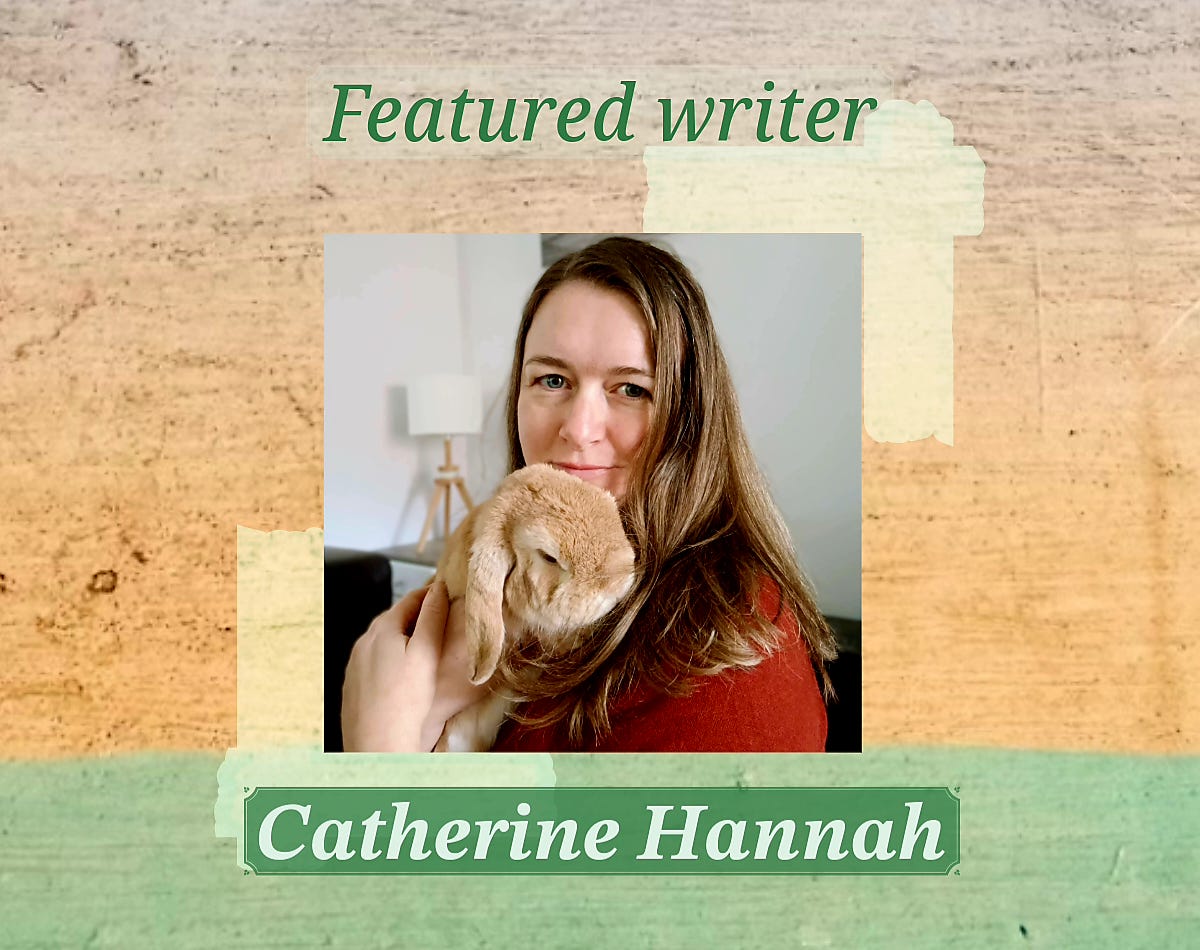
Once upon a grey day in May 2020, two vehicles collided when one driver decided not to stop at an intersection. Three people were injured, but -thankfully- no one died. So what I feel can’t be grief... can it?
As an early years educational leader and teacher-in-training, I placed value in supporting young children to name their emotions. Doing so helps the overstimulated individual to take a step back, thus encouraging emotional self-regulation. I suppose it’s similar to when I was an au pair - I would invite the children to name any spider we found around the house before releasing it outside. It’s harder to be scared of a huge hairy Huntsman once you’ve named it Wesley.
Lying in the hospital bed in my neck collar, I suppose I felt shock. Finding out that this particular injury is known as the Hangman’s Fracture - as the C2 vertebra is the one the executioner is aiming to break - compounded this. Later, when I would flinch and cry in the passenger seat whenever another car approached an intersection, I knew that was fear (I was diagnosed with PTSD three months post-crash). And in the months/years that followed, I could name the frustration I felt over word-finding difficulties, memory problems, dizziness and crippling fatigue; the result of a traumatic brain injury (now called Post Concussion Syndrome).
There was anger too, at having to give up my career as a result of my persistent symptoms; loneliness due to my reduced mobility; the physical pain; and a sense of injustice that none of this was my fault. There was something else too, but I just couldn’t identify it.
I tried to make sense of these emotions through journaling, but I found the practice too confronting. Then, a year after the crash, I wrote a poem. I found that by treating a challenging feeling as a project, I could take a step back, concentrating on structure and rhythm, perhaps rhyme. Then I could reread it and feel that same emotion, but this time - in an organised way - that made sense. I soon had quite a collection and began to wonder if my poems could help others as much as they had helped me. The Ballad of the Bunny and Other Poems: The Diary of a Car Crash and Beyond was published in February 2024.
It wasn’t until after this that something clicked - the process of understanding a feeling through writing a poem was similar to the process of taking a step back to name an emotion. Perhaps poetry could help me identify that niggling sensation?
Gradually, I began to understand that what I was feeling was, in fact, grief. I was grieving for the past I would never get back and the future that would never come to be. My previously active and social lifestyle has been defeated by my post-concussion exercise intolerance and the cognitive fatigue that accompanies conversation. The teacher I wanted to be for so long is gone - an early years classroom is no place for one whose symptoms are triggered by simultaneous sounds and unpredictable movement. My symptoms have also answered the question of parenthood. Even if I recover significantly in the next few years, I’m approaching forty. It would have been nice to have made that choice with my husband, rather than have it made for me by a stranger back in 2020.
Faceless
Why pine when no one is missing
or grieve when no one has died?
You spend all your time reminiscing
mourn a future that you were denied.
Bereaved through stolen choices
Hard work swept out with the tide
Lamenting the dwindling voices
In you
grief
finds places
to hide.
The concept of choice has been a significant part of my experience. For so long, it felt as though I had no control. Recognising that I needed time to grieve has helped me to understand that I can’t change what happened, but I can choose what to do next - an understanding that we can only embrace in our own time. For me, that has meant finally saying a dignified farewell to the early childhood profession and instead following the fulfilment I’ve found in writing into a career. I’m actually really excited about it! I am continuing to explore the concept of poetry for healing as I truly believe in its value as a writer and reader.
I wrote The Life of Sir Dunstan Pigglesworth initially as a poem to comfort my sister following the death of her pet pig. Fast forward to January 2025, and Dunstan is now published with my own illustrations to support families in holding grief - death can be difficult to talk about, so I hope this book will help start conversations. Dusted with gentle humour as well as sadness (and all the other emotions grief invokes) I wanted it to be a positive experience for all ages and leave readers with a sense of the love that we will always have for those we grieve for.
Grief is both universal and unique. However, whilst I learn to move on, the bereaved of loved ones learn to expand their hearts to make room for the grief that will always be there. This is where our experiences differ. Over the last couple of years, I’ve watched impotently as those dear to me have lost sisters, fathers, children, mothers, best friends. This is why I wanted to take part in Grief Stories; not only to share a less documented manifestation of grief, but to help raise the profile of those mourning a gap that will never be filled. There is comfort to be found in shared experience.
Grief is both universal and unique.
I wish you all the best in navigating your grief.
Grief Story by Catherine Hannah
Friend, have you ever experienced a loss that others didn’t recognise as grief — because “no one died”? Where might grief be showing up in your life in quieter or less obvious ways? Is there something in your own experience that feels easier to hold once it has a name?
Catherine Hannah is a poet, author-illustrator, and road safety advocate. Catherine was working and studying in childcare when she sustained life changing injuries in a car crash.
Catherine turned to poetry to make sense of her new life. She published her book, The Ballad of the Bunny and Other Poems: The Diary of a Car Crash and Beyond, as a way to reach others living with road trauma. She has also written/illustrated a rhyming picture book, The Life of Sir Dunstan Pigglesworth, to support families through grief.
Connect with Catherine on her website or Facebook and Instagram pages.
I’m so excited to share our next Live talk.
When?
Join my monthly Instagram Live series ‘What If This Is Grief?’ on Friday 19th June at 10 am CDT / 4 pm BST (UK) time.
I’m honoured to be joined by my wonderful guest Kathy Dye for another ‘What If This Is Grief’ Live series. Kathy is a Grief Stories contributor and you can read her story here.
We’ll be talking about the loss of a parent to Alzheimer's and processing layered living losses.
Friday 19th June
10 am CDT / 4 pm BST (UK)
If you have any questions for Kathy, please send me a message.
Set a reminder and join us live.
That is very interesting that writing poetry has helped to name emotions. In the past, I've written poetry to expunge emotion. I totally understand this type of grief, although mine is related more to my daughter’s addiction, I did receive a severe concussion in 2010, which resulted in a MTBI. I'm hoping to write about it in the next few weeks, but it sidelined my life. I never thought I would be able to write the same again. I was laid up in a dark room for 6 months, while my youngest 5 homeschooled kids struggled to get by without me. I lost several weeks of memory from before the accident, all the gr 11 math skills popped out of my brain and I struggled in any noisy environment. Crying in the grocery store became my new normal and leaving restaurants, showers, church functions and even my family's homes during family functions, became coping mechanisms. A brain injury is invisible. If only I had a dollar for every time someone said...oh, you're not still struggling with that are you? As if I was milking the injury. There were funny things too. I switched the beginning sounds of words in phrases. (Spelling is an issue---I just began to type frases even though I know it's wrong) I still say toin cossing for coin tossing and said something yesterday that made no sense. Sixteen years out, and I still type words with the letters out of order. For a long time I would add the ending letters to the next word. It took a long time to learn to type properly. This month, in 2015, my daughter was getting married and I had been looking after my parents who lived an hour away, after my mother broke her hip. Stress makes things worse. I was getting lost driving in familiar neighbourhoods and having other issues as well. I read a small study in which a doctor had given his Parkinsons, dementia and autistic patients Fiji water. It's high in silica and silica helps remove aluminum from the brain. He had them drink 1 liter over an hour every day for 2 weeks. Nearly every patient improved or reduced their symptoms. I decided to try it and I could feel the difference after 2 days. To this day, 16 years later, I will go buy a few bottles of Fiji water if I'm not doing well. And rest helps. I hope you do recover well. It's a very frustrating condition and I understand the grief associated with it. I know others who suffered this type of grief with concussion as it meant giving up a sport they were dedicated to and had committed a good chunk of their life and identity to.